DoorDash Returns
Effortless Returns for a Seamless Shopping Experience
Returning online purchases is a significant pain point for consumers, especially in the United States, with 40% preferring to sit in traffic over handling returns. DoorDash Returns is one of my recent school projects for the course 'Launching New Products'. This service is designed to eliminate friction by offering a seamless, end-to-end return experience, leveraging DoorDash’s existing network of drivers to pick up, package, and drop off returns at courier locations. By focusing on convenience, security, and efficiency, this service aims to drive high customer adoption and retention, creating a new revenue stream while reinforcing DoorDash’s leadership in last-mile logistics.

Collaborators
Carnegie Mellon Team
Course: Launching New Products
Methods
Market Research, User Survey & Insights, Pricing & Sales Strategy, Go-to-Market Strategy
Duration
5 weeks
The Problem
Returns after Online Shopping
Time Consuming & Inconvenient
Customers must package items, print labels, and visit return centers
Lack of Full Service Options
Existing solutions like Uber Connect Returns only provide pickup and drop-off, requiring users to complete packaging and labeling themselves
Trust & Security Concerns
Users are unsure if their returns will be processed within refund deadlines
Market Analysis
Market Sizing
-
Total Addressable Market (TAM): $817B in annual U.S. merchandise returns
-
Serviceable Available Market (SAM): $1.3B (based on online shoppers willing to pay $5 per return)
-
Serviceable Obtainable Market (SOM): $158M (targeting DoorDash’s 34M active users)
Competitive Landscape
-
DoorDash Returns stands out due to its full-service solution (pickup, packaging, and drop-off), real-time tracking, and integration into the existing DoorDash app ecosystem. This service offers a higher level of convenience and security, which are major pain points for online shoppers.
-
Uber Connect Returns offers only pickup and drop-off, making it less comprehensive than DoorDash Returns, especially for customers who require packaging services. However, it is simple and straightforward, making it appealing for quick returns.
-
UPS Returns focuses more on B2B and offers a trusted, well-established logistics network. Its business-focused model makes it less competitive for individuals looking for quick returns.


Market Trends (2023-24)
E-Commerce Growth
Online shopping boom $925B market, 11% CAGR
Customer Experience
Expectations rising, yet more retailers charging return fees
Sustainability
75% customers would pay for sustainable packaging
Subscription Services
Introduction of Uber One, DoorDash Pass memberships
Last-Mile Delivery
DoorDash capitalized on this segment, can leverage this
AI & Data Analytics
Predict return behavior, inventory and retail management
Product Vision
DoorDash is expanding their pipeline of service offerings to include a package returns service. DoorDash Returns is a service platform that connects customers to existing 'Dashers' to pickup, package and drop-off packages at any courier locations. The goal is make returns effortless so their shopping experience is seamless.
Core Value Proposition
Provides a hassle-free return process that eliminates the need for packaging, label printing, or visiting drop-off locations—ensuring a smooth, efficient, and reliable return experience.
Pickup, packaging, and drop-off included
END-TO-END SERVICE
Ensures transparency by notifying users on the progress
REAL-TIME TRACKING
Complying to this reduces customer anxiety
EFFORTLESS REFUND
Product-Market Fit
With e-commerce return rates increasing, a service that streamlines the process is in high demand.
30% of consumers are willing to pay for a return pickup service, creating a $158M serviceable market among DoorDash’s 34M active users.
User Persona
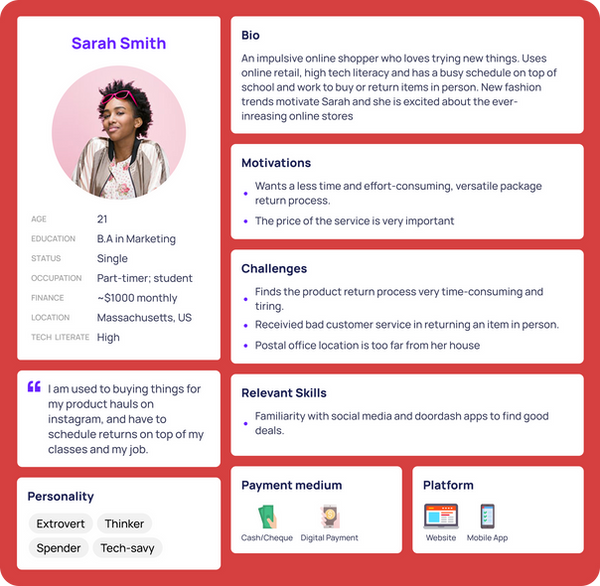
The Returner
Product Launch Goals
01
Trial
Encourage initial use of the feature for both drivers and users.
Target: 100,000 in 2 months
02
Retention
Ensure high repeat usage from customers and drivers.
Target: 40% of users use the service more than once within 3 months
$ 2.99
per return
via Dash Pass
(all inclusive)
Pricing Strategy
We will adopt a combination of competitive pricing and value-based pricing for the DoorDash Returns service. With competitive pricing, we aim to align our prices with market standards, similar to competitors like Uber Connect, which charges a flat rate of $5 for returns or $3 with a membership subscription. However, our service will offer more features, justifying a similar price point. With value-based pricing, we will focus on customer convenience, time savings, and security; we will cater to their needs and build loyalty, especially in the early stages of adoption.
$ 4.99
per return
+ $0.99 packaging
+$0.99 label
Go-To-Market Strategy
By focusing on simplicity, convenience, and seamless integration, the marketing plan aims to attract new customers and retain existing customers seeking a stress-free return solution.
Localized Campaigns
Tailor campaigns to specific cities will allow us to connect with customers on a more personal level and address local needs effectively
This example was made for Pittsburgh

Multi-Channel Strategy
Enterprises
Online Retailers
Integrate directly into their platforms
Courier Services
Leveraging their network and infrastructure
Intermediaries
Negotiations and API integrations
DoorDash Platform
Prominent placement and promotion


Media
Personalized Digital Advertizing
Prioritize Instagram to reach the target users
Email Campaigns
Existing DoorDash user base & online shoppers
Targeted Messaging
Cater to users' specific preferences
Influencers
Use their reach to spread awareness

_svg.png)


Sales Strategy
To capitalize on the growing demand for convenient returns services, and promote our all-in-one returns service.
Target frequent & occasional online shoppers in the US first before expanding internationally.
TEST MARKETS
Gather early user feedback and minimize risk
PRODUCT DEMOS
In-app demos and via digital marketing (TikTok)
TRIAL & REPEATS
First return free and other incentives
CONVERSION
Via social media, emails, ads, partnerships, testimonials
RETENTION
Incentives, excellent customer service, user-friendly
Measuring Success
Key Performance Indicators
The KPIs for DoorDash Returns are designed to ensure a seamless and scalable rollout, balancing early adoption with long-term engagement. With a goal of 100,000 users in the first month, the service aims to leverage DoorDash’s existing reach while driving initial traction through targeted promotions. The ambitious target of 2 million returns in the first year signals strong market potential, reinforcing the need for a convenient, tech-enabled return solution. Together, these metrics create a foundation for a frictionless experience, ensuring both customer satisfaction and operational success.
Initial Users
Achieve a 100,000 users in the first month
Driver Feedback
Achieve a 100,000 users in the first month
User Growth
20% repeat usage in 6 months
Churn Rates
At least 70% of the dashers accept requests
Usage Frequency
Average frequency of twice per month per user
Package Volume
First Year: 2 million packages returned
Brand Equity
Understand customer preferences
-
Survey customers to gauge why they choose DoorDash Returns over alternatives
-
Analyze data from e-commerce platforms to see how often DoorDash is selected for returns
Evaluate the economic impact
-
Track the number of subscriptions to the return program
-
Analyze revenue generated specifically from the return services
Monitor customer satisfaction
-
Regularly analyze online reviews and ratings on various platforms
-
Track and categorize customer complaints to identify areas for improvement
Strength Metrics
Financial Metrics
Preference Metrics
Complaints and Reviews
Customer Choices
Subscription and Revenue
Potential Risks & Challenges

Package Security

Customer Experience

Service Integration

Strong Competition

Logistics
Timeline & Future of Service
The timeline for DoorDash Returns outlines a structured growth plan, starting with partnership formation and technical integration , followed by marketing efforts and scaling operations. The focus then shifts to long-term growth through customer feedback and market adaptation. Key future initiatives include expanding to in-person store returns, increasing Dasher participation, and integrating with major online shopping platforms, ensuring a seamless and scalable return service.
Negotiations & Agreements (2-3 months)
Technical Integration
(4-6 months)
Expanding Partner Network (2-4 months)
Customer Feedback & Improvements
Partnership & Integration
Promotions
6-12 Months
Developing Marketing Materials (1-2 months)
Expansion & Scaling
4-6 Months
Scaling Up Operations
(2-4 months)
Long-Term Growth
(Ongoing)
Trend Analysis & Market Adaptation


